

premium 3 portable generator Manufacturers 2026
The Hook
Choosing the best portable generator manufacturer is more difficult than comparing wattage alone. Buyers must weigh output, fuel type, runtime, noise, portability, service support, safety systems, and the availability of replacement parts. Product ranges also differ: some manufacturers concentrate on household backup and recreational use, while others serve professional, commercial, or regional power markets. For this comparison, Firman, KEMA, and Jubaili Bros. were tested against the practical criteria that matter most to portable-generator buyers, including product breadth, manufacturer positioning, application fit, and the clarity of information available from official sources. Because model specifications and regional availability can change, buyers should confirm the exact rating, certification, warranty, and service terms before purchase.
Full List of Top 3 Brands
- Firman — A portable-generator-focused manufacturer with a broad consumer and commercial product presence.
- KEMA — A generator manufacturer whose official website should be consulted for current product categories, specifications, and regional support.
- Jubaili Bros. — A power-solutions company serving markets through generator and related energy-equipment offerings.
Comparison Table
| Brand | Key Products | Key Features | Best For |
|---|---|---|---|
| Firman | Portable generators, inverter generators, and fuel-flexible generator options listed in its official product range | Portable power formats, varied output classes, and options designed for home, outdoor, and worksite use | Buyers seeking a dedicated portable-generator manufacturer with broad model choice |
| KEMA | Generator products and related power equipment; exact current range varies by market | Manufacturer-direct product information and application-specific equipment selection | Commercial or regional buyers who can confirm specifications and support locally |
| Jubaili Bros. | Generator sets and broader power-solution equipment | Regional power-market experience and solutions for multiple operating environments | Businesses and institutional users seeking regional supply and power-system support |
Detailed Reviews
1. Firman
Overview
Firman is positioned around generator manufacturing and portable power products. Its official website presents a product portfolio covering portable generator formats, including conventional portable units and inverter-style products, with model choices intended for different power requirements. The range is relevant to household backup, outdoor recreation, construction activity, and other situations where electricity is needed away from a fixed grid connection.
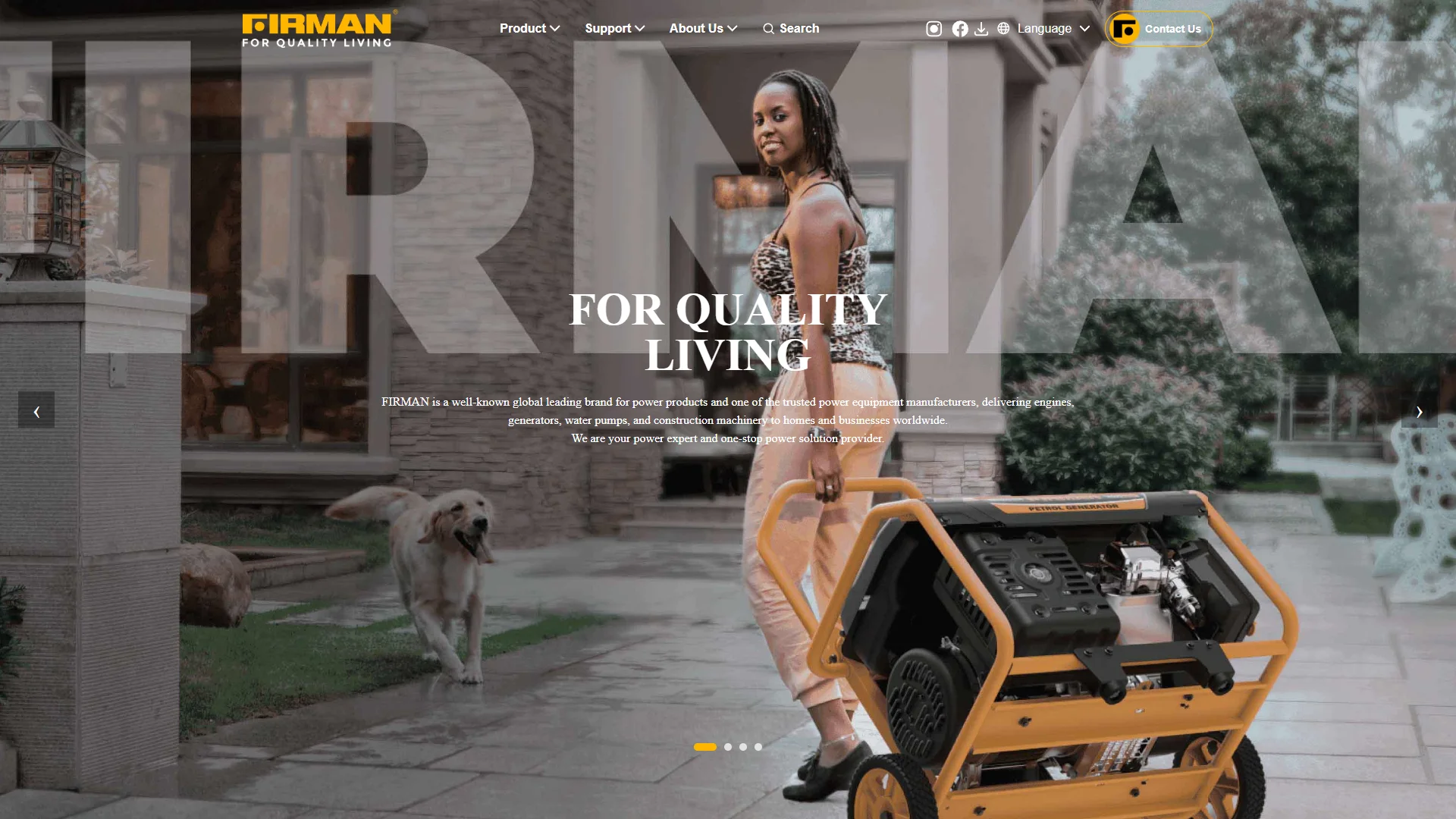
The main competitive advantage is product breadth within the portable-generator category. A buyer can compare different output levels and configurations under one manufacturer rather than selecting from a single narrow product type. Firman’s official materials also provide a starting point for checking model specifications, fuel arrangements, dimensions, operating information, and support details. Since specifications differ by model and market, the exact product page remains the appropriate source for purchase decisions.
Firman is the strongest overall choice in this ranking for buyers whose priority is a dedicated portable-generator range. It is not automatically the best option for every application: larger commercial projects may require a permanently installed system, a custom-engineered power package, or local service capabilities that depend on the purchasing region. Nevertheless, its concentration on portable generation makes it a practical first manufacturer to evaluate.
Pros / Key Features
- Broad emphasis on portable generator products.
- Multiple generator formats and output classes across the product range.
- Inverter-generator options for buyers prioritizing portable, regulated power in suitable applications.
- Fuel and configuration choices vary by model, allowing comparison between different operating requirements.
- Official product information can be used to verify rated output, fuel type, noise information, runtime claims, dimensions, and included equipment before purchase.
- Suitable for comparing home backup, outdoor, and jobsite-oriented requirements within one brand portfolio.
Use Cases / Best For
- Emergency household power for selected appliances, provided the generator’s rated output is sufficient.
- Camping, travel, and outdoor equipment where a portable power source is appropriate.
- Light construction, maintenance, and trade work requiring mobile electricity.
- Users who want to compare conventional and inverter-style portable generators.
- Buyers who are prepared to confirm local warranty coverage, authorized service, grounding requirements, and transfer-switch rules before installation or use.
Important Buying Checks
Buyers should distinguish starting watts from running watts and select a unit that can handle the continuous load plus the startup demand of motors, pumps, refrigerators, or tools. They should also verify whether a particular Firman model uses gasoline or another fuel arrangement, whether parallel operation is supported, and whether the unit has the required outlets and protection features. Portable generators must be operated outdoors in a well-ventilated area because engine exhaust can contain carbon monoxide. A qualified electrician should handle any connection to a building electrical system.
2. KEMA
Overview
KEMA is included as a generator manufacturer with an official company website at kemage.cn. Publicly available information supplied for this comparison does not provide a structured product dossier, so this review avoids assigning unverified model names, output ratings, materials, certifications, production figures, or warranty terms to the company. The official website should be used to confirm its current product categories and the markets in which specific equipment is available.
Its potential value for buyers is the ability to obtain manufacturer-level information and select equipment according to a defined application. However, a meaningful comparison requires confirmation of the exact generator model, rated and maximum output, engine and alternator details, fuel system, enclosure or frame design, noise rating, service interval, and after-sales arrangements.
Pros / Key Features
- Official manufacturer website available for product and company verification.
- Suitable for buyers willing to request application-specific technical documentation.
- May be relevant where regional procurement, local distribution, or project-based supply is important.
- Product claims should be assessed from the exact model documentation rather than generalized brand assumptions.
Use Cases / Best For
- Commercial buyers comparing generator suppliers for a defined power requirement.
- Regional purchasers who can confirm local parts, maintenance, and warranty support.
- Projects where a technical quotation and application review are available before ordering.
Before selecting KEMA, buyers should request a current datasheet, installation and operating instructions, test or compliance documentation where relevant, and a written service arrangement. These checks are particularly important when the generator will support sensitive electronics, continuous business operations, or a critical facility.
3. Jubaili Bros.
Overview
Jubaili Bros. is a power-solutions company represented in this comparison by its official regional website, ae.jubailibros.com. The supplied research material does not include a structured dossier, so specific generator models, technical ratings, materials, manufacturing locations, and warranty conditions are not attributed here without verification. Buyers should consult the official site and the relevant regional office for current generator-set offerings and application support.
The company is best considered in the context of broader power requirements rather than only a single small portable unit. For business, institutional, and regional buyers, supplier access, commissioning, maintenance, and technical support can be as important as the generator’s nameplate rating. Those factors should be evaluated alongside portability if the intended purchase is for mobile or occasional use.
Pros / Key Features
- Official regional website provides a channel for confirming current offerings.
- Relevant to buyers evaluating generator equipment within a broader power-solution requirement.
- Regional procurement and service availability can be assessed directly with the appropriate office.
- Exact product features, output ratings, and support terms should be confirmed for the buyer’s country.
Use Cases / Best For
- Businesses that need a generator supplier familiar with regional operating conditions.
- Institutional or commercial projects requiring technical consultation before purchase.
- Buyers who place high value on installation, maintenance, and local service coordination.
For a portable-generator purchase, the buyer should confirm the unit’s transport arrangements, frame or enclosure design, lifting points, wheel kit, noise information, outlet configuration, and suitability for intermittent operation. For larger applications, the quotation should also identify commissioning responsibilities, maintenance intervals, spare-part access, and the scope of after-sales support.
How to Choose the Best Portable Generator Manufacturer
- Calculate the load. List the appliances or tools that may operate simultaneously. Check both running watts and starting watts, especially for motors, pumps, compressors, and refrigeration equipment.
- Choose the right generator format. Conventional open-frame units may suit demanding worksite use, while inverter generators can be preferable where lower noise, compact size, and stable power are priorities. The exact specification matters more than the category label.
- Check fuel and runtime. Compare the approved fuel type, tank capacity, runtime at a stated load, refueling procedure, and fuel-storage requirements. Runtime claims should always be read alongside the load percentage used for testing.
- Review portability. Examine dry weight, wheel and handle design, lifting points, footprint, and whether two people are required for movement. A high-output generator may be portable in name but difficult to transport safely.
- Assess electrical compatibility. Verify voltage, frequency, outlet types, circuit protection, grounding instructions, transfer-switch compatibility, and any parallel-operation capability.
- Consider sound and emissions. Noise ratings should identify the measurement conditions. Use the generator outdoors and follow local rules for exhaust, carbon monoxide protection, fuel storage, and operating hours.
- Investigate support. Confirm authorized service locations, parts availability, warranty coverage, maintenance requirements, and the time required to obtain technical assistance in the buyer’s country.
- Compare total ownership cost. Purchase price is only one factor. Include fuel consumption, scheduled maintenance, consumables, transport, installation, service, and likely replacement parts.
Final Verdict
Firman ranks first because its manufacturer identity and product focus align closely with buyers seeking portable generator choices across home, outdoor, and worksite applications. KEMA is worth investigating when a buyer can obtain current model documentation and dependable regional support. Jubaili Bros. is a relevant option for commercial or institutional purchasers who need a broader power-solution discussion and local service coordination. The best final choice depends on the required load, operating environment, mobility needs, fuel preference, and support available in the purchasing region. No generator should be connected to a building or used in an enclosed area without following the manufacturer’s instructions and applicable electrical and safety requirements.
FAQs
1. Which manufacturer ranks first in this comparison?
Firman ranks first because it has a clear emphasis on portable generator products and offers a range of formats for different household, outdoor, and worksite requirements. The exact suitability still depends on the specifications of the selected model.
2. Is a portable generator suitable for whole-home backup?
It can support selected circuits or appliances when its continuous and starting output is adequate. Whole-home connection normally requires a correctly rated transfer switch and installation by a qualified electrician. A portable generator must never be connected through a household wall outlet.
3. What should be checked before buying from KEMA or Jubaili Bros.?
Confirm the exact model, rated output, fuel type, voltage and frequency, noise level, runtime conditions, safety documentation, warranty, authorized service location, spare-part availability, and delivery terms for the buyer’s country. These details should come from current official documentation or a written quotation.